
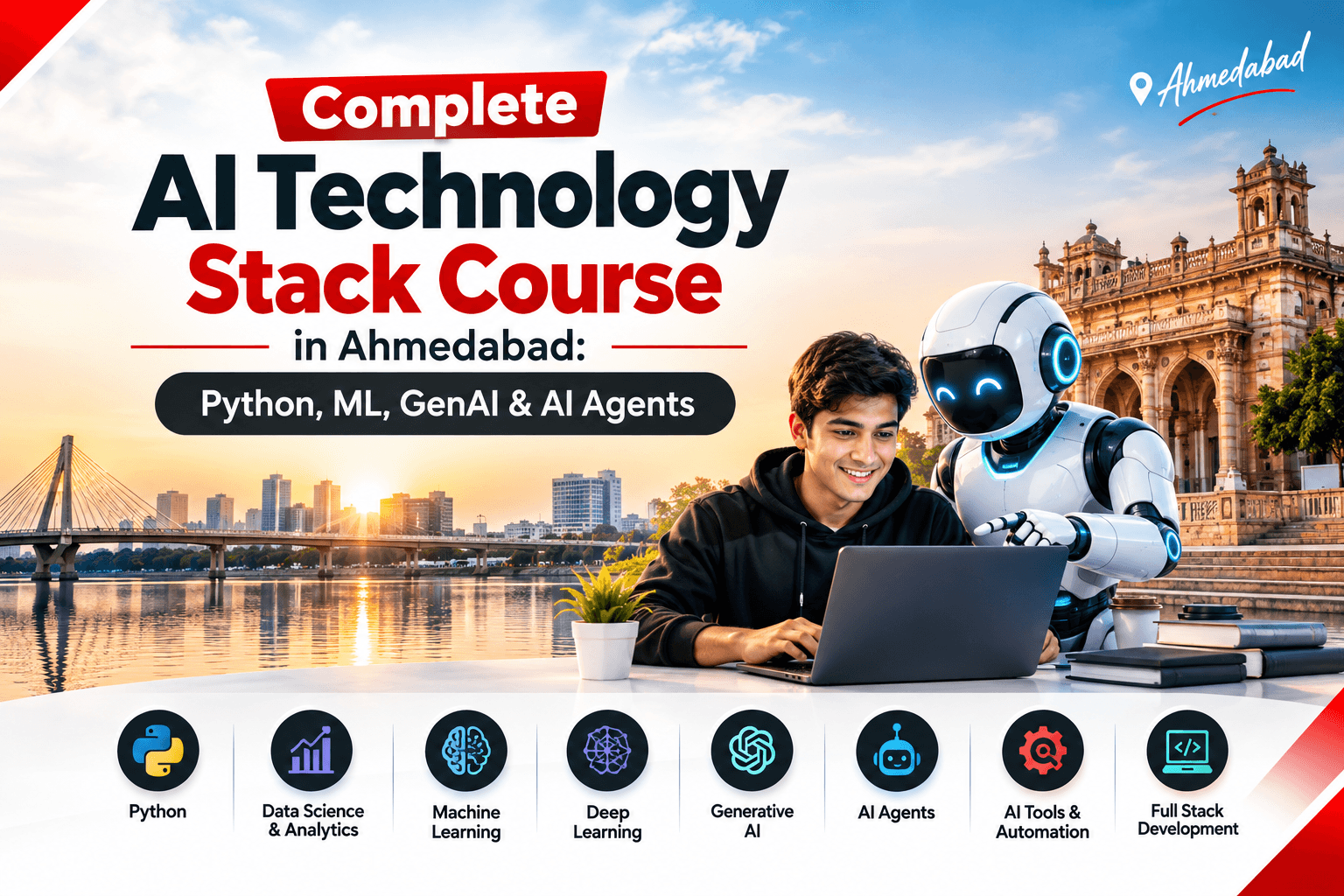
Complete AI Technology Stack Course in Ahmedabad: Python, ML, GenAI & AI Agents
Introduction
Artificial Intelligence is no longer the exclusive domain of large tech companies or a topic in science fiction movies. Today we are more and more immersed in artificial intelligence in our daily lives. AI is transforming how people work and how businesses function, from chatbots and recommendation systems to data analysis, content creation, and business automation.
If you’re a student or professional aspiring to a career in technology, a single AI skill might not be enough to get the full picture. Today’s AI applications are typically a combination of programming, data, machine learning, Generative AI, automation, APIs and application development.
This is why learning the complete AI technology stack in one course can be useful for learners who want to understand how different technologies connect. At Felix ITs Ahmedabad, learners can explore multiple areas of modern AI and technology through a structured learning approach.
Why Learn the Complete AI Technology Stack?
The AI ecosystem consists of a set of interlinked technologies. To be able to be used in Machine Learning, data have to be collected and analyzed first. You can combine Machine Learning with Deep Learning and leverage Generative AI and Large Language Models to build modern AI applications.
These artificial intelligence systems can then be connected to websites, databases and other software via APIs.
Learning each technology in isolation, without seeing how they all fit together, can sometimes be a confusing process. A structured AI course can help learners see the bigger picture and understand where each skill fits in.
This can be especially useful for students, freshers, working professionals, and people considering a career change into technology.
Python Programming
Python is one of the important bases of AI and Data Science. It is used widely for programming, data processing, automation, Machine Learning and AI application development.
Students can start by learning the basics of Python and then use Python for real-world AI and data projects. The aim is not to memorize programming syntax, but to learn how programming can be used to solve real problems.
For example, a business can use Python to manage customer information, automate repetitive tasks, analyze data, or connect an application with an AI service.
Data Science and Data Analytics
AI is data hungry. Businesses need to understand their data and identify useful patterns before building an intelligent system.
Data Science and Data Analytics enables learners to work with data, clean information, find trends and generate useful insights. Concepts involved in the learning process can include data processing, visualization, statistics and analytical techniques.
Take an online retailer, for example. The business may evaluate customer purchases to understand what products are popular, what customers are searching for and when demand is increasing
Machine Learning and Deep Learning
It is a field that allows computers to learn data patterns and use those patterns to make predictions or decisions. It is used in fields like recommendation systems, fraud detection, forecasting, classification and customer analysis.
Deep Learning goes further and uses neural networks to deal with more complex problems. It is commonly linked to applications such as recognizing images, natural language processing, speech-based systems, and high-level AI solutions.
Understanding Machine Learning and Deep Learning gives learners a foundation to explore more advanced artificial intelligence (AI) technologies.
Generative AI and Large Language Models
Generative AI has transformed the way we interact with tech. No longer is the role of AI to only present what is out there, but to create new material which includes text, images, code, summaries and more. Large Language Models which also known as LLMs are a key element in today’s AI world.
They are the force behind many of the modern AI assistants and applications. Also in this space we see learners look at topics like LLMs, prompt engineering, AI tools, and practical AI applications. Out of which they will gain the base to see how modern AI powered products are designed and put to use.
Agentic AI and AI Automation
AI has moved past basic question-and-answer tools. Agentic systems can break a task into steps, call external tools or APIs, and carry the work through to completion.For businesses, that means less repetitive manual work and smoother processes.
Consider a company whose staff gather data, write a report, and send out the morning update by hand. An AI system could handle part of that routine, leaving employees more time for work that depends on judgment and original thinking.
This makes Agentic AI and automation increasingly compelling areas for people pursuing modern AI careers.
API Integration and Full Stack Development
Knowing that you know AI theories is great but in practice what you see is that which is put together by a team which has built a full picture of the system.
We see that which models work best fit into a larger whole that also includes a frontend, backend, database, APIs and AI services that all play nice together. This is where Full Stack development and API integration comes in. Also we see how different elements of a system interact and how to put AI in to real world software products.
For example an AI which powers a web site may have a what the user sees on the front end, the which the app does on the back end, a database to store info and the AI model which is all connected via an API.
One Course, Multiple AI Technologies
One of the advantages which students see from a structured course that covers many technologies is that they are able to see how the skills play off each other instead of in silo.
At Felix IT in Ahmedabad our curriculum may include Python, Data Science, Data Analytics, Machine Learning, Deep Learning, Generative AI, LLMs, Agentic AI, AI automation, AI tools, API integration, and Full Stack tech.
We are not just presenting a large menu of tech options. What we are after is that students leave with a deep understanding of how to use these tools in tandem when we put together practical projects and solve real world problems.
Conclusion
AI world is growing at a rapid rate and we are seeing more integration of technologies in it. What we see today is that which learning Python, Data Science, Machine Learning, Deep Learning, Generative AI, Agentic AI, automation, APIs and Full Stack Development all out put is that they present a well rounded picture of the modern AI ecosystem.
Also just as learning to drive is about more than just starting the car, what we see in AI is that it is about understanding how these different technologies play together.
For students, freshers, professionals, and career changers in Ahmedabad, exploring a structured AI course in Ahmedabad can be a practical way to begin. Felix ITs Ahmedabad provides learners with an opportunity to explore multiple AI and technology concepts within one learning journey and gradually build skills through practical learning.
FAQs
1. What technologies are included in a complete AI technology stack?
A complete AI learning path can include Python, Data Science, Data Analytics, Machine Learning, Deep Learning, Generative AI, LLMs, Agentic AI, AI automation, API integration, and Full Stack Development.
2. Is Python necessary for learning AI?
Python is not the only programming language used in technology, but it is widely used for AI, Data Science, Machine Learning, automation, and application development, making it a useful foundation for AI learners.
3. Can beginners learn the complete AI technology stack?
Yes. Beginners can start with programming and data fundamentals and gradually move toward Machine Learning, Generative AI, Agentic AI, automation, and advanced AI applications through a structured learning approach.
4. What is the difference between Generative AI and Agentic AI?
Generative AI focuses on creating outputs such as text, images, or code. Agentic AI focuses on systems that can perform tasks, use tools, interact with external systems, and complete multi-step workflows.
5. Why learn multiple AI technologies in one course?
Learning connected technologies together can help learners understand how different parts of an AI application work together, from programming and data to AI models, automation, APIs, and complete applications.
Written by
Malik Himani
Felix ITs Editorial Team